Electroencephalography (EEG) has become an essential tool in both clinical and research settings due to its ability to non-invasively record brain activity with high temporal resolution. However, EEG signals are highly susceptible to various artifacts originating from technical and biological sources, such as muscle movements, eye blinks, and environmental interference. These unwanted signals can obscure or distort the neural information of interest, making accurate analysis and interpretation challenging. Effective artifact rejection is therefore critical for enabling reliable applications of EEG in areas such as epilepsy monitoring, brain-computer interfaces, sleep studies, and neurofeedback. This tutorial aims to equip readers with a fundamental understanding of common artifact sources and provides an in-depth discussion of current methods for artifact detection and removal.
Artifact Rejection from EEG Signals–A Tutorial
Technical Report
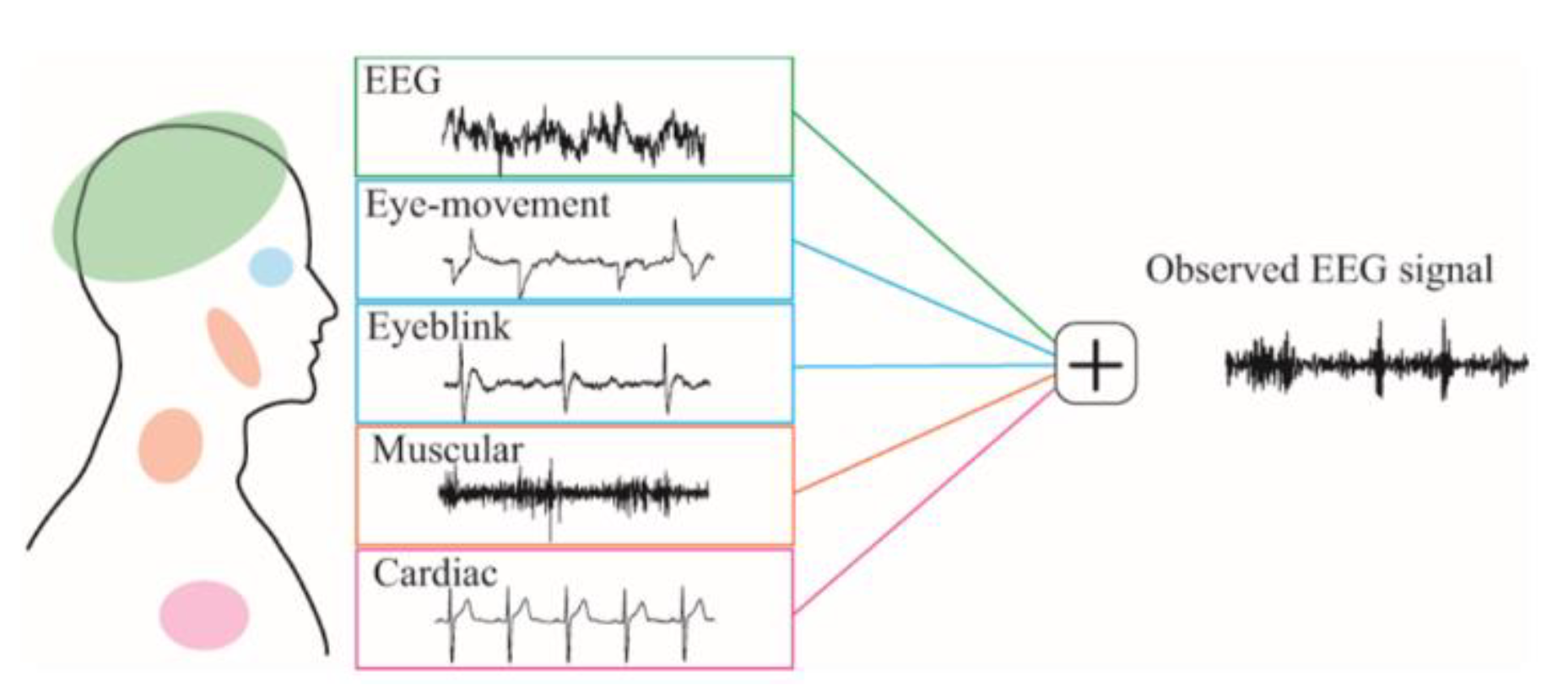
Abstract: This tutorial provides an overview of the challenges and solutions for artifact rejection in EEG signal processing, focusing on both multi-channel and single-channel scenarios. It summarizes key algorithms, discussing their effectiveness for online EEG systems and highlighting the ongoing need for robust real-time artifact removal.
Overview
Existing Methods
A variety of methods have been developed for artifact rejection in EEG signals, each with distinct advantages and limitations depending on the recording context. For multi-channel EEG data, blind source separation algorithms such as Principal Component Analysis (PCA) and Independent Component Analysis (ICA) are widely used to decompose mixed signals into independent components, allowing for the identification and removal of artifactual sources. Additional techniques include regression-based methods, which utilize reference channels to estimate and subtract artifact contributions, and adaptive filtering, which dynamically adjusts filter parameters to isolate the neural signal. For single-channel EEG, where these assumptions are harder to satisfy, approaches such as regression, band-pass and adaptive filtering, ICA-based signal decomposition (with extensions using wavelet transform or empirical mode decomposition), and non-negative matrix factorization (NMF) have been explored. While these methods have achieved varying degrees of success, challenges remain, particularly in real-time applications and in cases where artifact and neural signal characteristics overlap.
Conclusion
Artifact rejection remains a central challenge in EEG signal processing, especially as the technology becomes more accessible and is applied outside controlled laboratory settings. While multivariate statistical approaches like ICA have proven powerful for multi-channel recordings, their effectiveness diminishes in single-channel or portable EEG systems, where assumptions are often violated. Recent advances, such as supervised NMF and adaptive decomposition techniques, offer promising directions but often come with increased computational costs and complexity. Ultimately, successful artifact rejection requires a careful balance between removing unwanted components and preserving the integrity of the underlying neural signals. Continued research and integration of supervised learning and adaptive algorithms will be essential for realizing robust, real-time EEG systems suitable for routine clinical and everyday use.